
The best sales coaching platform for B2B SaaS depends on what's actually broken. Platforms like Mindtickle and Highspot solve readiness and content problems. Gong solves the visibility problem. AI practice tools like Hyperbound solve the preparation problem. MySalesCoach solves the execution problem — what happens in live deals when insight, training, and content still aren't translating into rep behaviour change. Most mature SaaS stacks need more than one of these.
There's a version of this guide that lists features, screenshots G2 scores, and tells you every platform is "powerful and easy to use."
This isn't that guide.
If you're a VP of Sales or sales enablement lead at a B2B SaaS company, you've probably already bought at least one coaching platform. You saw the demo, ran the pilot, rolled it out — and watched adoption fade by month three while your win rate stayed exactly where it was.
This guide is written for that person.
Before you read another feature comparison, answer this
What specifically is broken in how your reps execute right now — and at what point in the sales motion does it break down?
If the answer is "reps aren't practising enough" or "new hires take too long to ramp" — that's a readiness problem. Several platforms solve it well.
If the answer is "reps know what good looks like, managers know what good looks like, and it still isn't happening consistently in live deals" — that's an execution problem. Fewer platforms solve it. Most of them just give you better visibility into it.
That distinction is the lens this entire guide is written through.
TL;DR: best sales coaching platforms for B2B SaaS
The 5 best sales coaching platforms for B2B SaaS in 2026
1. MySalesCoach — best for rep execution in live deals
MySalesCoach is the only platform built specifically around the execution problem — what happens in live deals when data, training, and content still aren't changing how reps sell. Every rep is matched with a dedicated personal coach who works with them in regular 1:1 sessions, builds context on their specific deals over time, and is available for deal coaching support the same day. Reps coached weekly hit quota at 76% versus 47% for those coached quarterly, according to MSC's 2026 State of Sales Coaching research. The coaching compounds: a coach who knows a rep gets more precise over time, not less.
2. Gong — best for conversation intelligence and deal visibility
Gong is the category standard for understanding what's happening across your sales org at scale. Call recording, transcription, deal health signals, pipeline forecasting — it gives managers more to coach from and leadership clearer visibility into where pipeline is stalling. The limitation is structural: Gong surfaces insight but doesn't close the gap between insight and execution. For teams that already have Gong and aren't seeing performance move, the missing layer is almost always execution coaching.
3. Mindtickle — best for onboarding and sales readiness
Mindtickle handles the baseline well. Structured onboarding paths, certifications, skills assessments, and role play environments mean new hires ramp faster and managers spend less time on foundational knowledge transfer. For high-growth teams with a turnover problem or a ramp time problem, it's a strong fit. The transfer gap — from completed certification to consistent live execution — is where a coaching layer is needed alongside it.
4. Hyperbound — best for AI roleplay and call preparation
Hyperbound gives reps unlimited practice against AI-powered buyer personas before real calls. For onboarding, for drilling objections, for building confidence ahead of a high-stakes conversation — the volume of practice it enables is something human coaching structurally can't match. It operates entirely pre-deal, which means the gap between simulation and real buyer behaviour is exactly where its coverage ends and a human coaching layer begins.
5. Highspot — best for sales content and enablement
Highspot solves the alignment problem between what marketing produces and what sales actually uses. Playbooks, battlecards, and content surfaces at the right point in a deal. For teams with a content chaos problem or a gap between asset creation and field adoption, it handles the content layer well. Having the right material available doesn't guarantee a rep uses it effectively when a real buyer pushes back — that's a coaching problem, not a content problem.
How we evaluated these platforms
We didn't build this list around feature sets or G2 scores.
We looked at one question: does the platform actually change how reps perform in live deals?
More specifically — does it influence rep behaviour directly? Does it show up inside real sales activity, not just in training environments or post-call reviews? Does it move metrics that matter: quota attainment, ramp time, win rates?
Every platform in this guide is genuinely good at what it does. Where we flag limitations, it's not a criticism of the product — it's a structural observation about what the category it sits in can and can't do for you.
The category split that most buying guides get wrong
Sales coaching platforms in 2026 fall into four categories. Most buying mistakes happen because teams conflate them.
Readiness platforms — get reps to a baseline. Onboarding, certifications, content, playbooks. Valuable, but entirely pre-deal. The transfer from training into live execution is never guaranteed.
Intelligence platforms — surface what's happening. Call analysis, deal health, pipeline signals. Tells you what's wrong. Doesn't fix it.
AI practice platforms — simulate sales conversations. Reps roleplay against AI buyers to rehearse objections, discovery, and closing. Useful for preparation. Still pre-deal.
Sales Coaching Operating Systems — change what reps do in live deals, through ongoing human coaching embedded inside the actual sales motion.
Most mature SaaS sales stacks have the first two categories covered. The real question is which of the latter two closes your specific gap, and why they're not interchangeable.
Readiness platforms
Get reps to a baseline. Onboarding, certifications, content, playbooks. Valuable, but entirely pre-deal. The transfer from training into live execution is never guaranteed.
Intelligence platforms
Surface what's happening. Call analysis, deal health, pipeline signals. Tells you what's wrong. Doesn't fix it.
AI practice platforms
Simulate sales conversations. Reps roleplay against AI buyers to rehearse objections, discovery, and closing. Useful for preparation. Still pre-deal.
Sales Coaching Operating System
Always-on AI coaching in the background. Expert humans for the moments that matter. Plus tools to unlock the coaching talent already inside your business.
MySalesCoach are the only sales coaching platform built to work across all three.
— MySalesCoach
The AI practice vs human coaching debate — a direct answer
This is the question most VP of Sales are quietly wrestling with right now, and it deserves a straight answer rather than careful positioning.
What AI practice platforms do well
Platforms like Hyperbound are genuinely useful for repetition at scale. A rep can run thirty discovery call simulations before Monday without using a minute of manager time. For onboarding, for drilling a specific objection, for building confidence before a high-stakes call — the volume of practice available is something human coaching structurally can't match.
Where AI practice hits a ceiling
An AI can simulate a buyer. It cannot observe a rep across six real deals, notice they consistently lose momentum when a champion goes quiet after week two, and design a coaching plan specifically around rebuilding that pattern.
AI practice is preparation. It works before the deal.
The problem most SaaS sales leaders actually have isn't that reps are underprepared going into calls. It's that something breaks down in real deals — under real pressure, with real buyers, in situations no simulation exactly replicated — and there's no one there to catch it and correct it before the deal is lost.
That's not a practice problem. It's a coaching problem. And it requires a human.
Want to learn where AI fits in sales coaching? We have a guide here.
What about CRM-native coaching and AI-built platforms?
Two categories from the query data that come up constantly and deserve a direct answer.
CRM platforms with coaching features
Salesforce, HubSpot, and Microsoft Dynamics have all added coaching-adjacent features in recent years — call logging, activity tracking, manager dashboards. For teams looking at one less vendor, the appeal is obvious.
The limitation is structural. CRM coaching features are built around data capture, not behaviour change. They tell you what happened. They don't change what happens next. If you're evaluating a CRM for its coaching module, you're solving the visibility problem, not the execution problem. They're different problems.
AI-native sales coaching platforms
A newer category worth knowing about: platforms built entirely around AI — AI-generated coaching recommendations, AI-scored call analysis, AI-built rep development plans. Some of these are genuinely useful, particularly for teams with no coaching infrastructure at all.
The ceiling is the same one AI practice tools hit. AI can surface patterns and recommend actions. The gap between "the AI says do X" and "the rep does X consistently in the next six deals" still requires a human to close it.
Someone who knows the rep, can read resistance, and adjusts the coaching plan in real time. For teams that need scale without manager time, an AI-native platform is a reasonable starting point. For teams that need execution-level change, it's not the endpoint.
Why most sales coaching platforms don't move performance
The pattern is consistent across sales orgs of every size.
The tool gets bought. Rollout happens. Adoption is solid for six weeks. Then — gradually — it becomes another tab nobody opens, another dashboard nobody checks, another renewal conversation where someone asks whether it actually drove results.
This isn't a technology failure. It's structural.
Most platforms are built to surface information and expect humans to act on it. That works in organisations with exceptional managers who have time to coach, exceptional reps who consistently apply feedback, and a culture that treats skill development as a standing priority.
Most sales orgs aren't that. Most sales leaders already know they aren't that.
Kevin Beales, Founder and CEO of MySalesCoach, puts it directly:
"The problem with most sales coaching platforms isn't the technology. It's that it's always looking backwards. It can analyse what was said - but it can't see the belief that held the rep back from saying it.
It can flag the pattern. It can't shift the mindset and behaviour behind it. And without that, reps don't grow - they just get reviewed."
The numbers support it. MySalesCoach's State of Sales Coaching in 2026 research found that teams coached weekly hit 76% quota attainment. Teams coached quarterly or less: 47%. The single variable between those two groups was coaching frequency and consistency — not the tools in the stack.
Performance improves when coaching happens in real moments rather than retrospectively, when behaviours are reinforced consistently over time, and when execution is shaped and guided rather than just analysed. The distance between "the data says reps should do X" and "reps are actually doing X in deals" is where most of the revenue leakage happens.
Which sales coaching platform is right for you?
The right answer depends on what's actually broken in your sales motion right now.
Choose MySalesCoach if your managers know what good looks like, but performance still isn't moving consistently. You have data. You have training. What you don't have is someone making sure reps do things differently on the next call or in the next deal. That's the execution gap — and it's what MySalesCoach is built to close.
Choose Gong if you need visibility into what's happening across your sales org. You're flying blind on call quality, deal health, or rep activity, and you need a reliable data layer before you can coach effectively. Gong is the right foundation. It doesn't close the execution gap on its own, but it tells you exactly where it is.
Choose Mindtickle if your ramp time is too long, your onboarding is inconsistent, or you're scaling fast and new hires are taking more than three months to reach productivity. It's built for the readiness problem — getting reps to a baseline faster and more consistently than ad hoc onboarding allows.
Choose Hyperbound if your reps need more practice volume before calls, particularly during onboarding or when entering a new market or ICP segment. It's the right tool for building confidence and drilling specific objections at scale without using manager time to do it.
Choose Highspot if your content isn't reaching reps at the right moment in a deal. Marketing is producing assets that aren't being used, or reps are going into competitive situations without the right battlecards. Highspot is the content and enablement layer — it solves the access problem, not the execution problem.
Use more than one if you're a mature SaaS sales org. Most teams with 20+ reps need a readiness layer, a visibility layer, and an execution layer running together. The mistake is buying all three and expecting any one of them to do the others' job.
A closer look at each platform:
MySalesCoach — best for implementing a sales coaching operating system within your org
MySalesCoach is built on a premise the rest of the category hasn't fully committed to: the thing most likely to change how a rep sells is a real relationship with a skilled coach who knows them.
Every rep is matched with a dedicated personal coach - a specific person who builds context on their skills, their mindset, and their development over time. That relationship is the core of the product.
But it doesn't stop when the session ends. Behind the scenes, AI trained on the largest dataset of real sales coaching conversations in existence works continuously in the background - integrated into the tools and data your team already uses - so that coaching is always on, not just always scheduled.
What the coaching model looks like in practice
The personal coach relationship is supported by CRM integration that surfaces coaching triggers at the right moment - when a deal moves stage, when a risk signal fires, when a rep is heading into a high-stakes conversation. Not in a monthly review. In the deal.
Beyond their personal coach, reps get access to a network of specialist coaches across industries, sales motions, and deal types. If a rep is navigating an unfamiliar procurement process or trying to save a deal going sideways, they can get input from someone who's been in that exact situation — often the same day, sometimes within hours.
A Slack agent keeps coaching alive between sessions — flagging deal risks, prompting the rep at the right moment, and keeping managers informed without requiring them to dig into dashboards. Every rep has a personalised coaching plan co-owned with their manager, built around where they are and where they want to go — not a generic competency framework handed down to them.
Where it excels: Rep execution in live deals. Consistent behaviour change without depending on manager availability. Coaching that compounds over time because a coach who knows a rep gets more precise, not less.
What to know going in: This is a newer category — less brand recognition than Gong or Mindtickle. The value compounds over months, not weeks. If you need a quick-win metric for a board deck in 90 days, set expectations accordingly.
Best for: Teams that have visibility tools and training in place but aren't seeing performance move. Sales leaders who are stretched and can't personally close the coaching gap.
Hyperbound — best for AI roleplay and call preparation
Hyperbound lets reps practise sales conversations against AI-powered buyer personas before real calls. For teams that need to build practice volume fast — particularly during onboarding or when entering a new market — it delivers something human coaching structurally can't: unlimited repetitions without using any manager time.
Where it excels: High-volume practice before calls. Consistent simulation environment. Good for building confidence in specific scenarios and objections ahead of time.
Where it has limits: Operates entirely before the deal. Can't observe what's breaking down in real conversations. The better a rep gets at AI simulations, the more the remaining gap is the one between simulation and real buyer behaviour — and that gap has no AI solution.
Best for: Onboarding acceleration, pre-call preparation, drilling specific objections at scale.
Gong — best for conversation intelligence
Gong gives you visibility into your sales conversations at scale. Call recording, transcription, deal health signals, pipeline forecasting. If you need to understand what's happening across your org, it's the category standard for good reason.
Where it excels: Pattern recognition across hundreds of calls. Concrete material for managers to coach from. More defensible forecasting.
Where it has limits: Generates insight, not execution. The chain from "Gong surfaces a pattern" to "rep behaves differently in next week's deals" still requires a manager to coach and a rep to apply it. That chain breaks down more often than most vendors acknowledge. See MySalesCoach vs Gong for a full breakdown of how the two work together.
Best for: Sales leaders who need org-level visibility. Strong complement to an execution coaching layer — less effective as the only coaching investment.
Mindtickle — best for onboarding and readiness
Mindtickle is a well-built readiness platform. Structured onboarding paths, certifications, skills assessments, role play environments. For teams with a real ramp problem or high turnover, it handles the baseline well.
Where it has limits: Training and execution are different problems. Completing a certification doesn't guarantee a rep handles the live objection the same way when a real buyer pushes back. The transfer gap is real and consistent.
Best for: High-growth teams, high-turnover environments, anywhere a structured ramp programme is missing.
Highspot — best for enablement and content
Highspot organises content, playbooks, and battlecards and surfaces them for reps at the right point in a deal. Strong on the alignment problem between what marketing produces and what sales actually uses.
Where it has limits: Content doesn't change behaviour on its own. Having the right battlecard available doesn't mean the rep uses it well when the moment arrives.
Best for: Teams with a content chaos problem or a gap between marketing assets and sales execution.
How MySalesCoach compares to the leading platforms
If you're already running one of the major platforms and wondering where MySalesCoach fits, we've built detailed comparisons for the most common combinations. The ROI of Sales coaching is undeniable - here's what to expect when your reps get good quality, frequent coaching, how to measure it and how to put a business case together to invest in it.
MySalesCoach vs Gong
Gong gives you visibility. MySalesCoach gives you execution. The two are complementary when pointed at the right problems — Gong tells you what's breaking down, MSC changes it. Teams that try to use Gong as their coaching layer tend to find that insight without consistent follow-through produces dashboards, not results. Full breakdown: MySalesCoach vs Gong →
MySalesCoach vs Mindtickle
Mindtickle handles onboarding and readiness well. The gap it doesn't close is the one between completing a certification and executing the skill under pressure in a live deal. MSC sits downstream of Mindtickle in the coaching journey — once reps are ramped, consistent coaching is what keeps performance moving. Full breakdown: MySalesCoach vs Mindtickle →
What MySalesCoach reporting actually looks like
Most coaching platforms report activity. Sessions booked, calls reviewed, content completed. MySalesCoach reports outcomes — wins and results linked directly to coaching activity, tracked rep by rep.
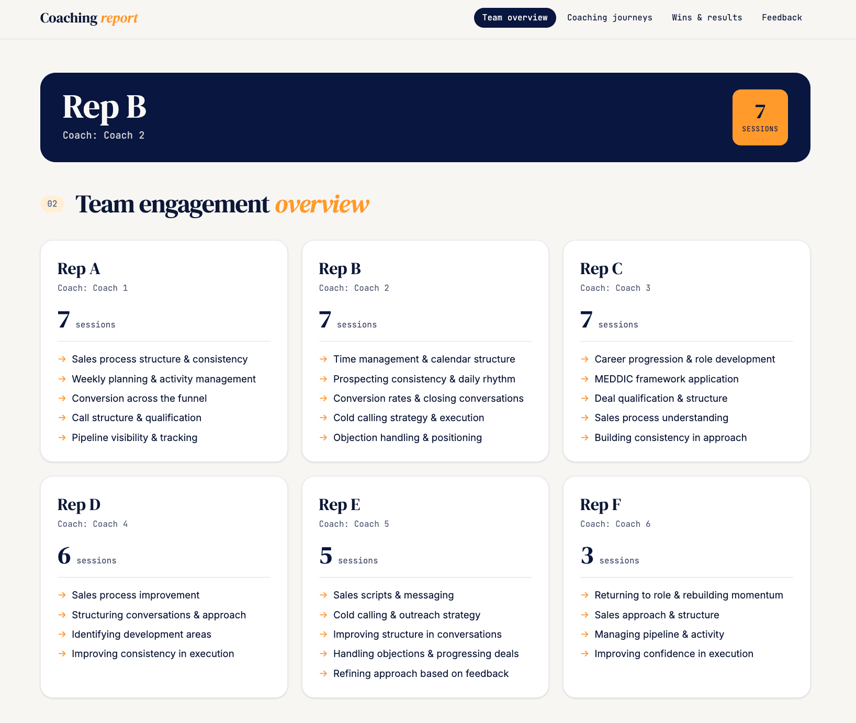
Every team on the platform gets a coaching report covering four areas: individual coaching journeys by rep, session engagement scores, wins and results tied to specific coaching work, and direct rep feedback on session value.
Here's what that looks like in practice, from an anonymised customer team of six reps:
Rep-level coaching journeys
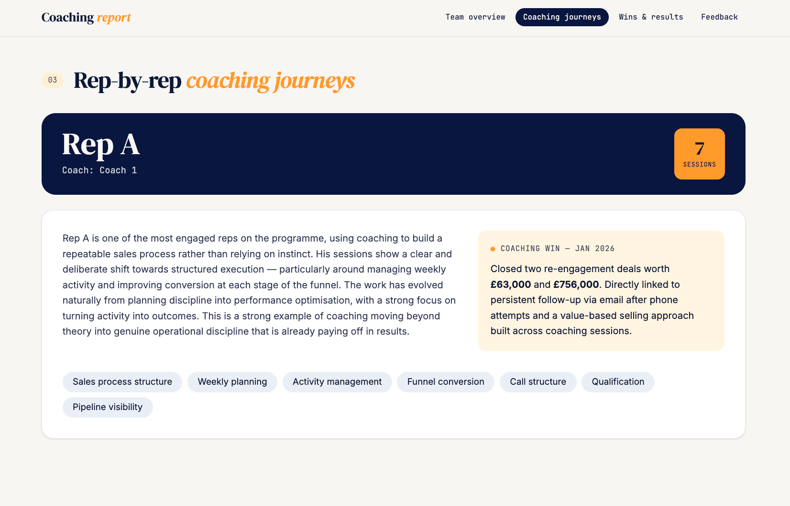
Each rep is matched with a dedicated coach and works through a personalised coaching plan built around their specific gaps — not a generic curriculum. Across this team, coaching topics ranged from cold calling strategy and objection handling for the SDRs, to MEDDIC framework application and deal qualification for AEs, to pipeline visibility and conversion across the funnel for reps earlier in their development. Seven sessions per rep over the programme period.
Wins linked directly to coaching
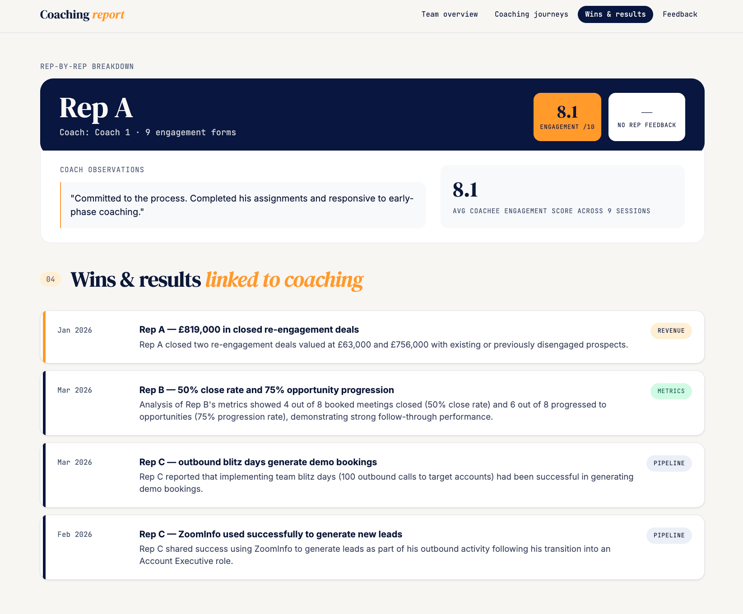
The report tracks commercial outcomes attributed to coaching work — not anecdotally, but tied to specific sessions and skills developed. From this team's programme:
- One rep closed two re-engagement deals worth £63,000 and £756,000 — directly linked to persistent follow-up via email after phone attempts and a value-based selling approach built across coaching sessions
- A second rep reached a 50% close rate and 75% opportunity progression rate across eight booked meetings
- A third rep ran outbound blitz days generating demo bookings — a tactic developed and refined in coaching sessions
Engagement and feedback scores
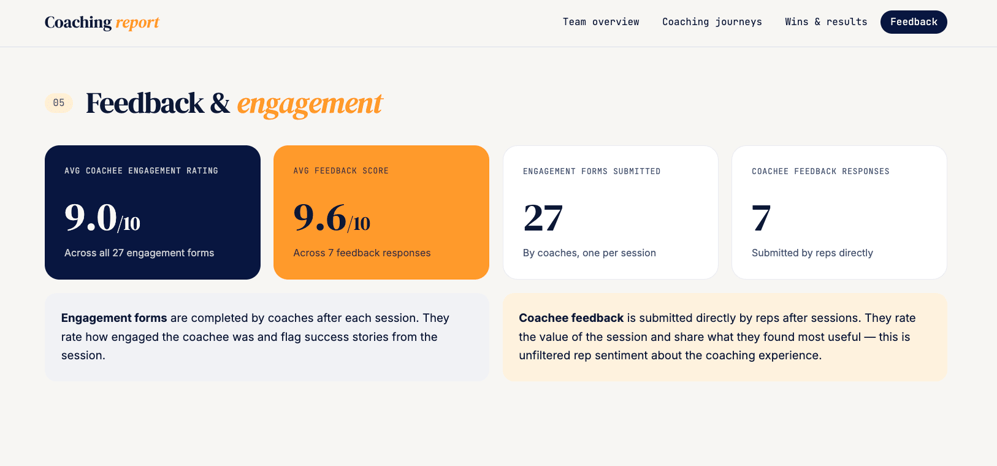
Coaches complete an engagement form after every session. Reps submit feedback directly after sessions — unfiltered sentiment on session value.
Across this team: 9.0/10 average coachee engagement rating across 27 sessions, 9.6/10 average rep feedback score across 7 responses.
These aren't NPS scores collected six months after a contract ends. They're session-by-session data that shows whether coaching is landing — and flags early when it isn't.
What this answers for buyers evaluating platforms
If you've been burned by a coaching platform that generated dashboards but not results, this is the transparency layer that's usually missing: named focus areas per rep, commercial outcomes linked to specific coaching work, and direct rep sentiment — not just manager satisfaction scores.
What to look for when you're evaluating any sales coaching platform
Does coaching happen inside real deals — or only before and after them?
Tools that operate only in training environments or post-call reviews create a transfer problem. The further coaching is from the moment of execution, the less reliable the behaviour change.
Does it reduce the coaching burden on managers, or increase it?
If the platform generates more for stretched managers to review, it's adding to the problem rather than solving it. The platforms worth investing in make coaching happen without depending entirely on manager availability.
Is there a human in the loop who actually knows your reps?
AI can flag, simulate, and pattern-match. What it can't do is build the contextual understanding of a specific rep — their history, their psychology, their particular sticking points — that a skilled coach develops over months. For execution-level change, that relationship is the variable that matters most.
What does behaviour change actually look like, and how long does it take?
Push every vendor on this. "Our dashboards surface recommendations" is not an answer. Ask what specifically changes in rep behaviour, on what timeline, measured how. Any vendor who can't answer that question concretely is telling you something important.
Which platform fits your situation
Frequently asked questions
What are the best sales coaching tools for a VP Sales?
The best sales coaching tools for a VP Sales depend on which gap you are trying to close. MySalesCoach is the tool for a VP Sales whose team already has data and training but still is wanting to drive performance and win more deals — matching each rep with a dedicated personal sales coach who's walked in their shoes and works with them in regular 1:1 sessions to support growth and development. MySalesCoach also have same day deal coaching available to support AE in winning their most critical deals at their time of need.
What's the difference between AI sales coaching and human x AI sales coaching?
AI coaching works through simulation and pattern recognition — available at scale, consistent, and good for practice volume. Human coaching works through relationship and judgment built over time. The difference matters most in live deals: AI can prepare a rep for a conversation but can't observe what's actually breaking down and correct it in real time. For execution-level change, the human element is the hardest variable to replace. At MySalesCoach, we offer human coaching powered by the frequency of AI.
How does MySalesCoach measure and report coaching outcomes?
MySalesCoach produces a coaching report for every team on the platform covering four areas: rep-by-rep coaching journeys with named focus areas per session, commercial wins linked directly to coaching activity, session engagement scores completed by coaches after every session, and direct rep feedback on session value. From one anonymised customer team of six reps: average coachee engagement of 9.0/10 across 27 sessions, 9.6/10 average rep feedback score, and commercial outcomes including £819,000 in closed re-engagement deals and a 50% close rate attributed directly to skills developed in coaching. This is session-by-session data, not a satisfaction survey sent six months after contract end. See the full breakdown in the reporting section below.
Can AI replace a human sales coach?
For practice and preparation, AI handles much of what used to require manager time. For the kind of coaching that changes how a rep behaves under pressure in a real deal — which requires knowing the rep, understanding their specific patterns, and building a plan around them — not yet. The gap between simulation and a real buyer in a real deal is exactly where skilled coaching earns its value.
We already have Gong. Do we need another tool or platform?
It depends on what Gong is actually doing for you. If managers are consistently acting on insights and rep behaviour is changing as a result, you may have the loop closed. If the insight is strong and performance still isn't moving, the gap is almost always execution — and that's a different tool's job.
Do I need both AI practice and human coaching?
Possibly — they solve genuinely different problems. AI practice builds volume and confidence before deals. Human coaching shapes what happens during them. Teams serious about performance often use both: AI practice for onboarding and preparation, human coaching for the execution layer in live pipeline.
How does MySalesCoach work alongside tools we already have?
MySalesCoach connects to your CRM to surface coaching triggers at the right point in live deals. It integrates with Slack so coaching stays active between sessions. It's designed to sit alongside intelligence tools like Gong — the insight layer and the execution layer solve different problems and are genuinely complementary when pointed at the right ones. Use our sales coaching ROI calculator to model what closing the execution gap is worth for your team.
What results should we expect, and how quickly?
Leading indicators — call quality, stage conversion rates, rep confidence on specific scenarios — typically move within the first few months. Durable behaviour change takes longer. The honest answer is that a personal coaching relationship compounds over time: the longer a coach knows a rep, the more precisely they can target what needs to change. Set expectations with your leadership accordingly.
Is MySalesCoach right for smaller sales teams?
The personal coaching model works well regardless of team size. For smaller teams, personal coaching can add the know-how and skills that may not yet exist within the team and elevates the entire business, whilst for bigger teams it can drive individual growth and performance that lead to organisational success
Is MySalesCoach suitable for larger sales teams?
Yes. The need for coaching doesn't diminish as teams grow - it intensifies. MySalesCoach data shows that the range of experience, capability, and skill across a larger sales org is wider, which makes personalised 1:1 coaching more necessary, not less.
For teams with a sales enablement function, the challenge shifts: it's less about individual skill gaps and more about creating a culture of consistent behaviour change across the whole organisation. MySalesCoach addresses this directly.
Larger orgs also tend to surface a second coaching need that smaller teams don't: frontline sales manager development. The MySalesCoach coaching operating system isn't only for reps - it's a structured way to coach the people managing your reps, so the development compounds through every layer of the team.
Whether you have three reps or 300, the coaching model scales with you.
Which sales coaching platforms are best for B2B sales coaching at scale?
Scaling coaching is where most platforms hit a structural ceiling. Content and readiness platforms scale well — you can push the same onboarding programme to 200 reps as easily as 20. The harder problem is scaling the human element: consistent, personalised coaching that actually changes behaviour across a large team — whether that's SDRs struggling to book meetings or AEs losing deals at late stage — without depending entirely on manager availability. MySalesCoach is built for this — a network of specialist coaches matched to reps by role, motion, and skill gap, with CRM integration and a Slack agent that keeps coaching active between sessions. Each rep has a dedicated coach. The coaching scales because the model does, not because the human element has been automated away.
What's the best sales coaching platform for onboarding SDRs?
SDR onboarding has two distinct problems that need different tools. The first is ramp speed — getting SDRs to a baseline of methodology, messaging, and confidence fast. Readiness platforms handle this well. The second is what happens after onboarding, when SDRs are in live prospecting sequences and still not booking meetings at the rate they should. That's where human coaching earns its value. MySalesCoach matches SDRs with coaches who have run SDR teams themselves — coaches like Neil Bhuiyan, who has coached 3,500+ SDRs over eight years — and builds a coaching plan around the specific gaps showing up in their actual prospecting activity, whether that's cold call confidence, multi-channel sequencing, or converting discovery into qualified pipeline. How those sessions are structured matters as much as how often they happen. How to run sales coaching sessions that actually work covers the common traps managers fall into.
Which sales coaching platforms do high-performing GTM and revenue teams use?
High-performing GTM teams tend to run layered stacks rather than a single platform. Gong or similar for visibility into what's happening across the sales motion. A readiness platform for onboarding and certifications. And a sales coaching execution layer — increasingly MySalesCoach — for the gap between what those tools surface and what reps and SDRs actually do when they're in front of a prospect. The teams that treat coaching as a continuous process for every role in the revenue org — not just AEs, not just new hires — consistently outperform those that don't. MSC's 2026 research found weekly coaching produces 76% quota attainment versus 47% for quarterly coaching. The cadence matters as much as the content, across every role.
Which sales coaching platforms show transparent data on adoption and performance lift?
Most platforms report activity metrics — sessions completed, calls reviewed, certifications passed. These are adoption measures, not performance measures. The harder number is actual performance lift: what changed in meeting booking rates, win rates, quota attainment, or ramp time as a direct result of coaching activity — across SDRs and AEs alike.
MySalesCoach produces a coaching report for every team covering rep-by-rep session activity, commercial wins linked to specific coaching work, coach engagement scores after every session, and direct rep feedback on session value. From one customer team of six reps: 9.0/10 average coachee engagement across 27 sessions, 9.6/10 average rep feedback score, and outcomes including £819,000 in closed deals attributed directly to skills built in coaching. That's the level of transparency most platforms don't offer — because most platforms aren't tracking outcomes at that granularity. See the full breakdown in the reporting section above, or view the 2026 State of Sales Coaching research for the broader data on sales coaching and the impact on performance.
The thing most sales leaders already know but platforms won't say
You probably don't have a data problem. You have an execution problem.
The dashboards exist. The call recordings exist. The training content exists. What doesn't exist — consistently, at scale, without depending on a manager having a free hour — is someone making sure reps actually do things differently in the next deal.
That's a solvable problem. It just requires a different kind of tool from the ones that created the dashboards.
Want to understand whether execution is actually your bottleneck before you make any decisions? Talk to our team and we'll help you figure out what's the best route to take.