

In sales, defining your Ideal Customer Profile (ICP) is a foundational step. An ICP is a detailed description of the types of companies — specific accounts — that your team should target for the best possible results. Think of it as a blueprint that defines who's most likely to benefit from your product or service and bring value back to your business in return.
A strong ICP considers factors like company size, industry, pain points, and growth stage. It's less about casting a wide net and more about laser-focusing on the highest-potential clients.
What is an ICP in sales? An ICP (Ideal Customer Profile) is a detailed description of the company types your sales team should target to achieve the best results. Unlike broad demographic targeting, a strong ICP specifies the exact firmographics, pain points, growth stage, and buying triggers that predict success. Sales teams with a clearly defined ICP convert more efficiently, build better playbooks, and onboard new reps faster — because everyone knows precisely who they are selling to and why.
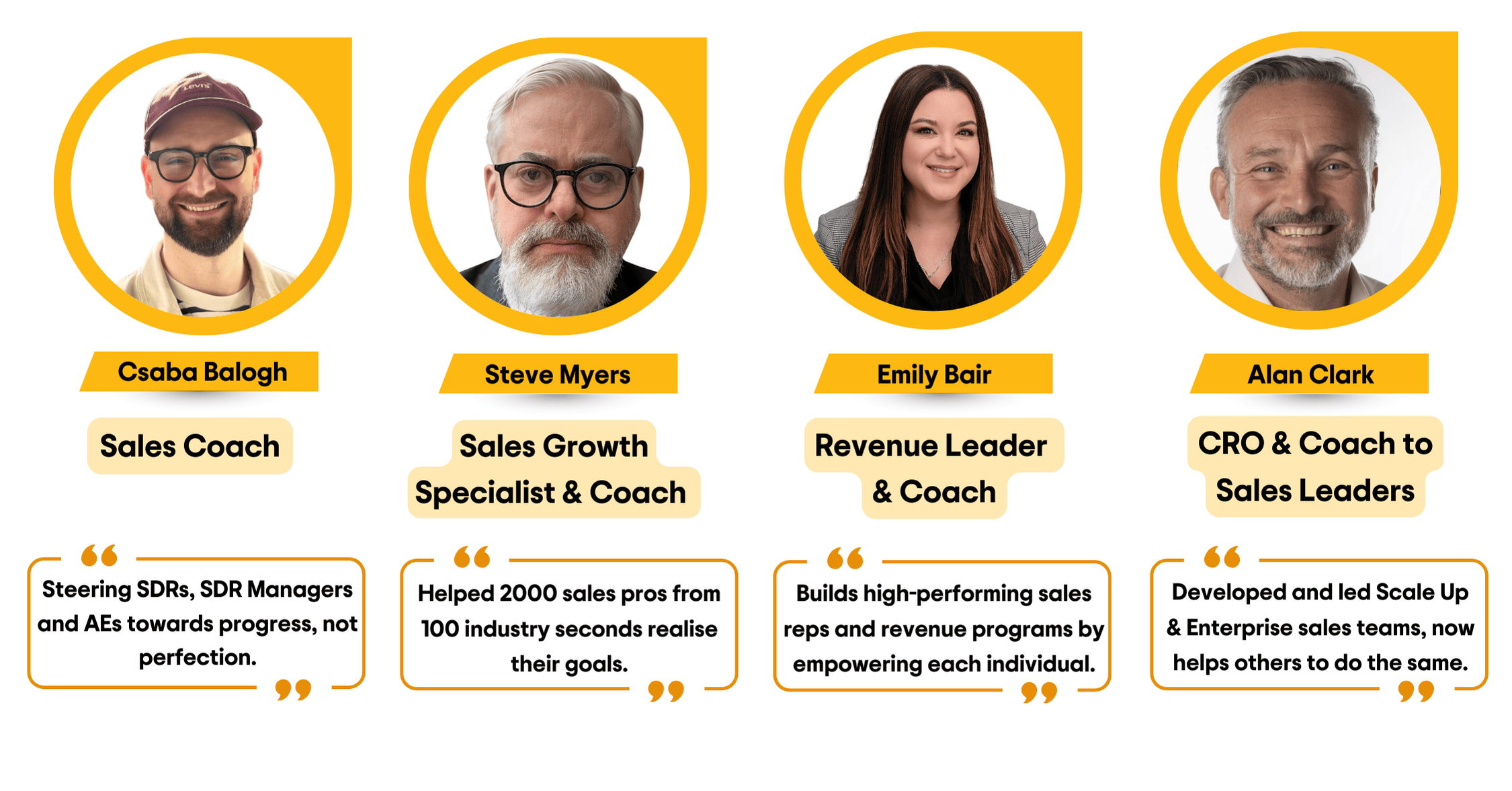
The coaches providing the insight on building your ICP in this post are Csaba Balogh, Steve Myers, Emily Bair and Alan Clark.
1. What is the Most Critical Element in Creating an Effective ICP, and Why?
When defining an ICP, the coaches all agree: specificity and focus are key.
For Alan Clark, a sales leader with 20+ years building SaaS sales teams who scaled net new ARR from £5m to £16m in three years and achieved a trade sale exit to Sage at over 10x ARR, success lies in honing in on the precise problem you're solving rather than just relying on broad factors like industry or company size.
"An ICP that's focused on solving a specific problem can often transcend categories like geography or industry," Alan says.
He suggests looking for accounts that are in "growth mode" or facing a particular challenge.
"If you can dominate a small subcategory, you can leverage that foothold to expand into adjacent spaces with similar needs."
Steve Myers, who has coached over 3,000 salespeople in 40 years in the profession and spent nine years as MD at Sandler, adds that understanding why your best customers actually do business with you is the cornerstone of a strong ICP.
"Ask what pain points they had before, the business impact of those issues, and how they felt about it," Steve suggests. "This emotional insight helps you connect on a deeper level, moving you from a vendor to a trusted advisor."
Csaba Balogh, Head of Coaching Excellence at MySalesCoach, who has scaled SDR teams from 40 to 100+ reps, trained over 500 salespeople, and influenced more than $160m in pipeline, points out that an effective ICP must clearly differentiate between the customer account and the persona.
"An ICP defines the company you're targeting, while personas define the individuals within that account who will be involved in the buying process," Csaba says.
Csaba highlights the importance of establishing this clarity from the start so that the ICP is strategically aligned at the company level, allowing the team to focus on the account holistically before tailoring messaging to individual roles.
This account-first thinking aligns directly with qualification frameworks like MEDDPICC which treat the buying organisation's structure as the primary filter before individual stakeholders are mapped.
If you want to get your team utilising MEDDPICC, we have a learning path available.
Emily Bair, a former VP Sales and Sales Enablement Director who has trained over 500 sellers, stresses the importance of understanding how your product fits into the business objectives and professional goals of your ideal customer.
"It's not just about finding accounts that would be good for us as a company; it's about determining why our solution is ideal for them and their growth," Emily explains.
Top Tips:
- Get specific with your ICP. Focus on unique challenges and business needs, not just demographics.
- Understand the "why" behind current customers choosing you — it provides a blueprint for finding more.
- Think about your ICP from the customer's perspective: why is your solution the best fit for their goals?
- Differentiate between the account-level ICP and individual personas to ensure alignment across teams.
2. What Common Mistakes Do Companies Make When Defining or Not Defining Their ICP?
The coaches agree that when ICPs are poorly defined, or missing altogether, resources are often wasted. According to Steve, failing to define an ICP is like throwing darts in the dark.
"Without an ICP, there's no clear direction for sales or marketing, and teams end up targeting everyone and anyone," he emphasises.
Even when teams do attempt to build an ICP, Steve observes they often focus too narrowly on the business itself and overlook the human side.
"What's keeping the decision-makers up at night? What are their professional fears and aspirations? Without that, you're just throwing mud at the wall."
Alan points out another common pitfall: relying too heavily on basic demographics like size, industry, or geography.
"This broad approach often dilutes focus," he says. "Instead, look for nuanced qualifiers like the stage of growth or a unique operational challenge. This specificity separates the high-potential accounts from the rest."
Csaba and Emily both note that companies can often be overly inward-focused when building ICPs, designing them around what's best for the business rather than what's best for the customer.
"A true ICP should reflect why the solution is ideal for the client and not just for your revenue goals," Emily Bair.
Csaba adds that some companies confuse ICP with persona profiles, focusing on job titles rather than account needs.
"This can create a lead-based, persona-focused approach rather than an account-based strategy," he warns.
Top Tips:
- Avoid casting too wide a net — go beyond broad demographics and target based on specific challenges.
- Don't make ICPs about just what's best for your business; think from the customer's perspective.
- Recognise the difference between account-level ICP and individual personas to avoid scattered targeting.
3. How Does Having a Clear ICP Influence Sales Strategy and Team Performance?
A well-defined ICP brings clarity and consistency across the sales team. Alan notes that with an ICP, reps can tailor their messaging more precisely, addressing detailed problems rather than speaking in generalities.
"It allows the team to dive deep into specific issues, which makes for more relevant, impactful conversations," - Alan Clark
When reps know exactly who they're speaking to and what issues they're addressing, they become more effective.
For Steve Myers a clear ICP means that strategy becomes scalable and measurable.
"When everyone knows the ICP, you can build playbooks and sales coaching techniques that are directly relevant to it," he suggests.
The structure of your sales coaching sessions should reflect your ICP directly — the scenarios you practise, the objections you rehearse, and the discovery questions you sharpen should all be drawn from your highest-value accounts.
Csaba Balogh highlights the confidence boost that comes from a clear ICP.
"With an ICP, reps aren't second-guessing who to target, which increases activity levels and makes reps feel more empowered," he says.
Emily Bair agrees with this stance, comparing a targeted ICP to offering steak to a room of meat-lovers rather than vegetarians.
"Even with the best playbooks, if you're in the wrong room, it won't matter. With the right ICP, you're putting your resources in the room that wants what you're offering," she explains.
Top Tips:
- A clear ICP streamlines messaging, leading to more focused and impactful sales conversations.
- It allows for repeatable, scalable strategies and effective onboarding for new reps.
- ICP clarity improves rep confidence, empowering them to approach each prospect with focus and intent.
4. What Tactical Steps Should Sales Teams Take to Identify and Refine Their ICP?
When it comes to identifying and refining an ICP, the coaches emphasise listening to your customers and looking at data. Alan Clark recommends spending time with existing clients to understand the specific benefits they experience.
"By learning directly from your clients, you can better define what your next ideal client looks like," he says.
Steve Myers suggests client interviews as an essential step.
"Ask customers what issues led them to your company, the impact of those issues, and how they felt about the solution's benefits," he advises.
This not only refines the ICP but also provides insights into potential objections or additional pain points to address in future sales.
For SDR-led teams in particular, ICP clarity at the prospecting stage is the single biggest driver of pipeline quality — and SDR coaching that reinforces ICP discipline from day one compounds that effect over time.
Csaba Balogh believes the RevOps or Enablement teams should take charge of defining the ICP. In cases where those teams don't exist, sales leaders can help by segmenting the ICP by tiers, such as Enterprise, Mid-Market, and SME.
"Having tiered ICPs helps teams to target more effectively based on company characteristics like size, revenue, or specific challenges," Csaba says.
Emily Bair advocates for a data-driven approach by analysing CRM records, especially close-won and close-lost data.
"Look at what's working and what isn't. Be brave enough to pivot based on the results," is her advice.
Top Tips:
- Dive into customer feedback to refine the ICP based on real-world benefits and success stories.
- Conduct customer interviews to identify patterns in challenges, benefits, and responses.
- Use data analysis to validate and adjust your ICP over time, keeping it relevant as markets evolve.
5. Can You Share an Example Where Redefining the ICP Led to Significant Sales Growth?
The coaches had several examples where refining the ICP directly led to increased sales success.
Alan Clark shared a story about his HR tech team, which originally targeted a broad market. They later found that companies with international teams had a stronger need for their currency-handling features.
"After adjusting our ICP to focus on companies with cross-country teams, we saw an increase in win rates," he says. "Initially, we handled fewer leads, but those we engaged were higher quality, leading to more predictable results."
Steve recalls a time when his team worked with gas turbine engines and initially included oil and gas clients in their ICP. However, after interviewing customers, they found that oil and gas clients had less need for their services due to redundant systems.
"By removing that segment from our ICP, we saved time and refocused resources on clients who truly needed us, driving meaningful growth."
Emily Bair's consulting work with a major health website demonstrated the value of targeting the right vertical. Her client's new division was underperforming, and her ICP analysis revealed they were targeting the wrong market.
"After shifting focus, they went from a struggling pipeline to tens of millions in new business," she says.
Csaba Balogh adds that redefining ICP often means going to where prospects are — in his case, trade shows for enterprise clients.
"When we refined our ICP and met clients where they were, we saw deal sizes rise and a steady growth in high-value opportunities."
Identifying where your ICP congregates — whether at industry events, in specific online communities, or through particular channels — is itself a core part of sales prospecting [link: https://www.mysalescoach.com/blog/sales-prospecting] strategy.
Top Tips:
- Refine your ICP based on real results; sometimes, adding specific qualifiers like international reach can make all the difference.
- Don't be afraid to remove unqualified segments from your ICP to focus on higher-value prospects.
- Align your ICP with market opportunities — attending industry events or exhibitions can be a powerful tactic for high-value ICPs.
Frequently Asked Questions About ICP in Sales
What does ICP stand for in sales?
ICP stands for Ideal Customer Profile. In sales, it refers to a detailed description of the type of company most likely to buy your product, succeed with it, and bring the highest value back to your business. It defines account-level fit — firmographics, pain points, growth stage — before individual buyer personas are considered.
What is the difference between an ICP and a buyer persona?
An ICP defines the company you are targeting; a buyer persona defines the individual within that company involved in the buying decision. ICP-first thinking means you qualify the account before you tailor messaging to the people inside it. As Csaba Balogh explains, leading with an account-based strategy rather than a lead-based approach keeps the entire team focused on the right opportunities.
How do you build an ICP for a B2B sales team?
Start with your close-won data. Analyse your best customers for shared firmographics — size, industry, growth stage — the specific pain they had before buying, and the business impact your solution delivered. Steve Myers recommends direct customer interviews to capture not just the facts but the emotional context: what were decision-makers worried about, and how did that change after they bought?
How often should you update your ICP?
Most sales leaders revisit their ICP annually at minimum, and after any significant shift in their market, product, or competitive landscape. Emily Bair recommends using CRM close-won and close-lost data as a continuous feedback loop rather than a once-a-year exercise — markets evolve, and so should your targeting criteria.
What happens if your sales team does not have a clear ICP?
Without an ICP, reps default to targeting anyone who might buy, which dilutes pipeline quality, stretches resources, and makes it impossible to build repeatable playbooks. Steve Myers describes it as throwing darts in the dark — activity without direction. The result is lower conversion rates, longer sales cycles, and a team that cannot be coached consistently because everyone is selling to a different type of customer.
Wrapping Up: The Power of a Well-Crafted ICP
Creating a strong ICP is a strategic move that helps teams focus on accounts with the highest potential, reducing wasted efforts and increasing the likelihood of success.
As the coaches shared, building or refining your ICP is an ongoing process that requires insight into customer needs, an openness to test new criteria, and a commitment to evolve. With a well-defined ICP, you'll save resources, improve engagement, and build a foundation for sustainable sales growth. For a practical guide on putting that foundation to work, see our guide on how to coach your sales team [link: https://www.mysalescoach.com/blog/how-to-coach-your-sales-team].
TL;DR: How to Build a Winning ICP for Sales Growth:
- Define a Clear ICP: Target high-value accounts that best benefit from your product/service, focusing on pain points and growth stages.
- Avoid Common Pitfalls: Steer clear of broad demographics and focus on challenges that align with your ideal customers' needs.
- Boost Sales Strategy: A well-defined ICP streamlines targeting, messaging, and boosts sales team confidence.
- Use Data and Feedback: Continuously refine your ICP with customer feedback, CRM data, and analysis of close-won/lost deals.
- Drive Growth: Align ICP with market opportunities, focusing on accounts likely to yield consistent, impactful results.
Looking for further Sales Leadership tips?
Why not check out some of our guides around: sales coaching techniques, sales team building activities and how to master sales team leadership.